
Back Pain Treatment in Royal Palm Beach | Chiropractor for Lower and Upper Back Pain
What Causes Back Pain?
Maybe it started when you bent down to pick up your kid. Or you woke up one morning and couldn't get out of bed without wincing. Could've been that yard work last weekend, or honestly—you have no idea when it started, but now it's affecting everything.
Sound familiar?
You're in the right place. I'm Dr.Frost and I've been treating back and neck pain for years. I've seen just about every type of back problem you can imagine, from the "I tweaked something and it'll probably go away" variety to the "I literally cannot move" situations.
Here's what I know: back pain is complicated. It's also incredibly common—about 80% of people will deal with it at some point. But just because it's common doesn't mean you should have to live with it.
The Thing About Back Pain Nobody Tells You
Your back didn't just "go out." That's not actually a thing, even though it feels like it.
What really happens is this: you've probably had some underlying issue—muscle imbalances misaligned vertebrae, immobile joints, whatever its is—for a while. Then one day you do something totally normal like bend down to pick up your kids or tie a shoe and your back flairs up.
The good news? The vas majority of back pain isn't caused by anything serious. You probably don't need surgery. You definitely don't need to just "tough it out" or rely on pain meds forever.
What you need is someone to figure out what's actually causing the problem. That's where chiropractic care comes in.
Types of Back Pain We Treat
The "I Can't Stand Up Straight" Pain (Acute Lower Back Pain)
This is the classic. You bent over to tie your shoe, and now you're stuck at a 45-degree angle. Every movement sends a sharp pain through your lower back.
What's usually happening: Your facet joints (the little joints between your vertebrae) got irritated, or you strained the muscles and ligaments in your lumbar spine. Sometimes both.
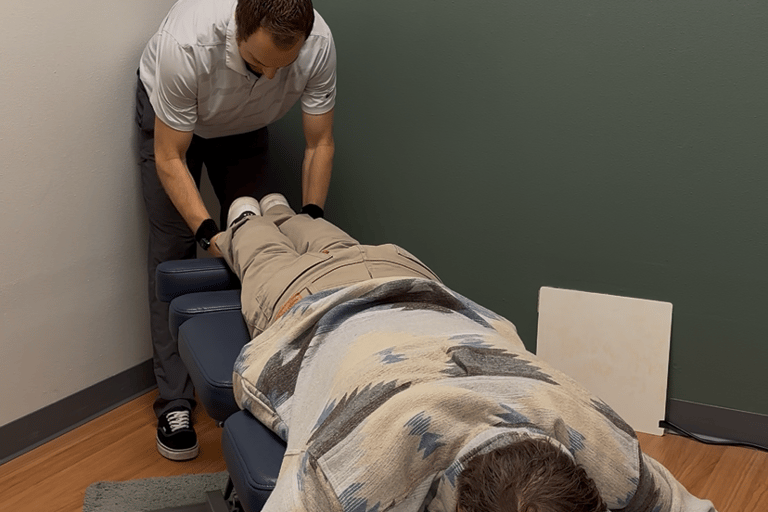
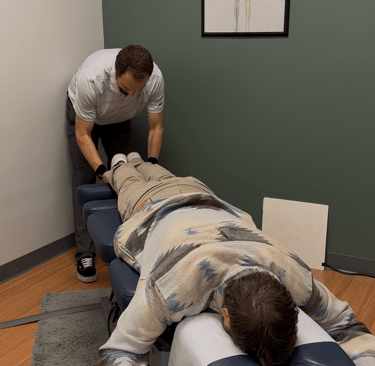
How we help: Specific adjustments to restore proper movement to those locked-up joints and focussed soft tissue work to release the muscle spasms. Most people feel at least some relief after the first visit depending on the level of inflammation/irritation to the joints and tissues. Typically these require several visits over a couple weeks.
The "It Never Really Goes Away" Pain (Chronic Lower Back Pain)
You've had this for months, maybe years. Some days are better than others, but it's always there in the background. You've learned to live with it, but you shouldn't have to.
What's usually happening: There's probably multiple things going on, sometimes structurally—disc degeneration, arthritis, chronic muscle imbalances, or long-standing misalignment or joint dysfunction. Your body's been compensating for so long that now to deal with the pain or injury and now it is affecting other areas.
How we help: This takes longer to fix, I'll be honest. The longer an area has been injured, inflamed, or dysfunctional the longer it takes to treat. There's generally no way around it. We need to retrain your spine and the muscles supporting it. That means regular adjustments, exercises you'll do at home, and probably some lifestyle changes. But people who stick with it? They have a very high likelihood of seeing significant improvement that drastically improves your quality of life.
Upper Back and Shoulder Blade Pain
This one's huge for people who work at desks. That burning, achy feeling between your shoulder blades that gets worse as the day goes on. Sometimes it can also feel as if you can not get full breath in due to your ribs not being able to expand properly or your spine to move properly.
What's usually happening: Your thoracic spine (mid-back) is stiff and locked up from sitting hunched over, and now the muscles are over compensating. Sometimes there's rib dysfunction too. Ribs can and do get irritated especially with the long hours of sitting in poor posture, which our bodies were not designed for.
How we help: Thoracic adjustments feel amazing and is one where patient often feel the most pronounced immediate relief. We'll also work on your posture and give you some recommendations for at home and at work.
Why Your Back Pain Hasn't Gone Away Yet
If you're reading this, you've probably already tried a few things. Maybe they helped a little, or maybe they didn't help at all. Here's why:
You're treating the symptom, not the cause. Pain meds, muscle relaxers, heating pads—these can make you feel better temporarily. But if the underlying problem is a joint related or a muscle imbalance, the pain will keep coming back.
You stopped too soon. A lot of people feel better after a few treatments and quit whether it be with chiropractic or physical therapy. Then six months later, they're back where they started. Healing takes time, especially if you've had the problem for a while.
You're doing the wrong exercises. Not all back exercises are good for all types of back pain. The same can be said for stretches, which can also potentially make things worse depending on what's causing your back pain and how you are doing them.
Nobody's looked at your whole body. Your back pain might be coming from the joints in your back, discs, tight hip flexors, weak glutes, or even the way you walk. Everything's connected and the body will aways make compensations so you can move around.
What Makes Our Approach Different?
We Actually Listen
I know—every doctor says this. But here's what I mean: I'm going to ask you a lot of questions. When did it start? What makes it worse? Better? What have you already tried? What are you hoping to be able to do again?
I need to know if you're trying to get back to playing with your grandkids, training for a marathon, or just making it through a workday without constant pain. Because that changes the treatment plan.
We Don't Use Cookie-Cutter Treatment Plans
The adjustment that works great for someone with a disc issue might be totally wrong for someone with sacroiliac joint dysfunction. We tailor everything to your specific problem.
We're Big on Patient Education
You're going to understand what's wrong and why we're doing what we're doing. I'll show you on a model spine if I need to. Knowledge is power, and you deserve to know what's happening in your own body.
We Give You Tools to Help Yourself
You're only here a couple times a week (at most). The other 23+ hours a day? You need to know what to do. We'll teach you stretches, exercises, and ergonomic tips that actually work for your situation.
We're Honest About Timelines
If your back has been hurting for five years, I'm not going to tell you we'll fix it in three visits. But I will give you a realistic timeline and milestones to watch for. And if something's not working, we'll adjust the plan.
Your First Visit: What Actually Happens
Step 1: We get a detailed history and discuss about what's bringing you in
This will allow me to get a better idea your injury, how it started, why it started, where it may be coming from ect. This is also a great time for you to discuss any concerns you may have regarding your injury, treatment or whatever else it may be.
Step 2: Examination
We will do a focussed exam and check your range of motion, posture, and how your spine moves. I'll feel for areas that are tight, misaligned or dysfunctional. Sometimes I'll also have you do certain movements to see what reproduces your pain.
Step 3: Imaging (If We Need It)
For some conditions, X-rays help me see exactly what's going on. X-rays are only are not necessary for the vast majority of patients before beginning treatment however if we do need them, I'll explain what I'm looking for before we proceed to get any imaging.
Step 4: The Plan
We will sit down go over the findings from the history and exam, and then we'll map out a treatment plan together.
Step 5: Treatment (Usually Same Visit)
If it's appropriate, we'll start treatment that day. Most people are surprised by how much better they feel after that first adjustment.
How Long Will Treatment Take?
Depends on a lot of factors:
Acute pain (just happened): Could be 1-2 weeks of treatment, maybe 2-6 visits total.
Chronic pain (been dealing with it for months/years): We're looking at several weeks to a few months. Maybe 12-20 visits, sometimes more.
Maintenance (keeping it from coming back): After we get you feeling better, some people choose to come in monthly just to keep things in good shape. Totally up to you. Some people need this, some don't.
I'll give you a better estimate after I examine you. And if you're not improving at the pace we'd expect, we'll reassess. Sometimes we need to adjust the approach.
Common Questions People Ask
Will the adjustment hurt?
Most people find it relieving, not painful. The first adjustment may be mildly sore in some people and you might be sore the next day, like after a good workout especially if you never have been adjusted or it has been some time since your last adjustment. That's totally normal and usually means we're making changes. But the adjustment itself? Rarely does it cause it pain.
What's that popping sound?
That's nitrogen gas bubbles releasing from the joint capsule when it get opened up. Same thing that happens when you crack your knuckles. It's not your bones grinding or anything breaking.
Do I have to keep coming forever?
No. My goal is to get you better and teach you how to stay better. Some people choose to come in periodically for maintenance. Others don't. Your call.
I'm scared of chiropractors. I've heard stories.
I totally understand. There are videos online that make it look scary or aggressive. That's not how I practice. Everything we do is controlled and if you're not comfortable with something, we won't do it. Chiropractors have some of the best, if not the best safety profile of all the healthcare professions which is why our malpractice insurance rates are so much lower than that of traditional medical doctors. You can see some data on that here on our general FAQ page.
What if my back pain is caused by something serious?
Part of my job is screening for red flags. If I suspect something that needs more intensive medical attention or is out of my scope—like a fracture or tumor—I'll refer you out immediately. Most back pain isn't serious, but when it is, we always do our best to get you into the care you need.
Do you take insurance?
We're a cash-pay practice, which keeps costs transparent and affordable. For auto accident cases, we work with PIP insurance. No insurance hassles for everyday treatment, though. We also accept HSA/FSA as well.
Can you help if I've already had back surgery?
Typically, yes. Depends on what surgery you had and when. We'll need to review your surgical records, but chiropractic can absolutely help with post-surgical pain or adjacent segment issues.
Serving Royal Palm Beach, Wellington, West Palm Beach, and Loxahatchee
We're right here in Royal Palm Beach, which means you're not driving all the way to Boca or Miami for quality chiropractic care. Plenty of parking, easy to get to from US-98, State Road 7 or Southern Boulevard.
Patients drive in from Wellington, Loxahatchee, and West Palm Beach too. We're worth the short trip—and your back will thank you.
Stop Living with Back Pain
Look, I can't promise miracles. But I can promise you'll get honest, evidence-based care from someone who genuinely wants to help you feel better.
You don't have to keep canceling plans because your back's acting up. You don't have to spend another weekend on the couch because you're in too much pain to do anything.
Give us a call or directly at (561) 780-8035 or book online with the buttons at the top and bottom of the page. Let's figure out what's causing your back pain and get you back to living your life.
Frost Chiropractic
11931 Southern Blvd, Suite 320
Royal Palm Beach, FL 33411
Serving Wellington, West Palm Beach & Loxahatchee
Schedule Online
P: (561) 780-8035
F: (561) 220 - 1299
© 2025. All rights reserved.